What Should a First AI Build Scope Include Before You Commit?
By Zechariah Myrick · August 30, 2026 · 8 min read
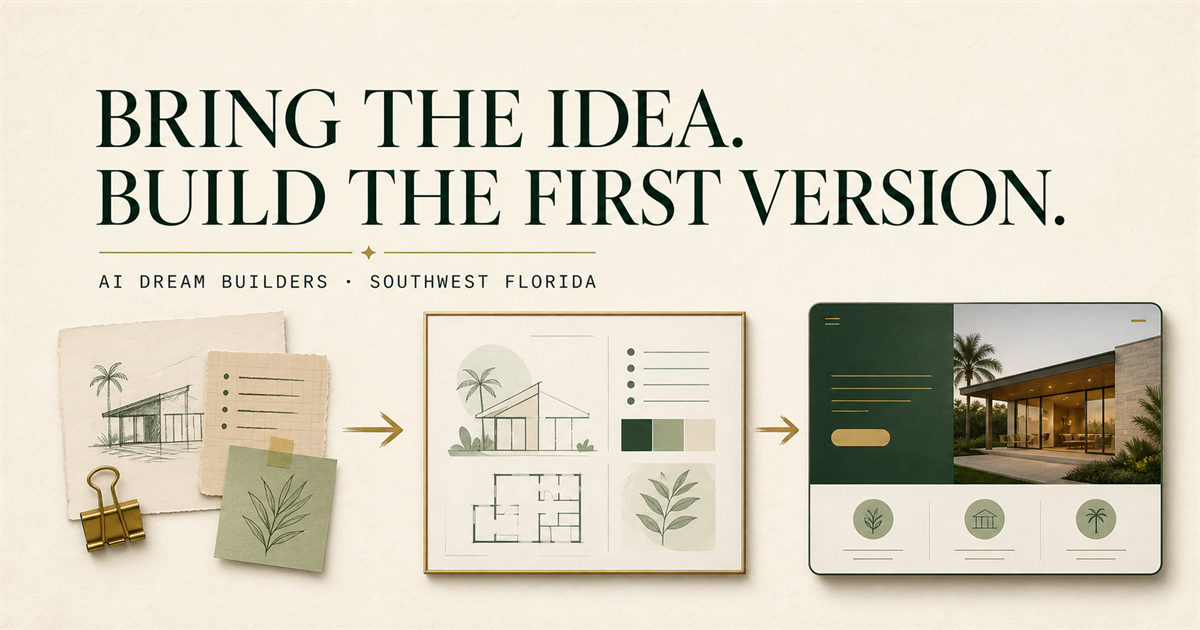
Before you commit to a first AI build, write down five things: one visible outcome, the material that is safe to use, what stays out, who owns the decision, and what the small version must clarify next. That short scope is not a contract or a promise that the idea will work. It is a way for a Naples or Collier County decision-maker to decide whether there is a bounded, paid-worthy first version to choose and build—rather than a vague request for ‘an AI app.’
A first-version scope makes a conversation and a small build more accountable. It does not establish demand, cost, accuracy, security, legal compliance, or a finished product.
A scope is a decision boundary, not a feature list
A capable professional, owner, adviser, consultant, manager, or serious founder may have a useful subject-matter insight, a sketch, a website problem, or an unfinished ChatGPT conversation. That is enough to start clarifying a first version. It is not enough to responsibly promise every integration, exception, audience, or outcome a future product might have. Start with the question: ‘What could another person see, try, or review that would make our next decision more honest?’
The U.S. Small Business Administration describes market research as work that helps a business understand customers and improve an idea. A first-version scope is smaller. It can test one uncertainty or make one service explanation tangible, but it cannot substitute for customer research, permissions, specialist review, or evidence that a market exists.
The Greater Naples Chamber's Micro Business Council describes practical support for Collier County micro-businesses. That is local context, not proof that any particular AI project is needed or will succeed. It is a useful reminder that a small business owner can set a clear next decision before committing resources to a broad build.
Use this five-part first-version scope check
Use public, fictional, or material you are authorized to discuss. This is a planning worksheet, not legal, security, financial, or professional advice.
- 1. One visible outcome: Name the smallest thing another person could see, try, or review. It might be a public explanation page, a clickable concept, a human-run checklist, or a bounded demonstration—not a complete platform.
- 2. Safe starting material: State the approved public summary, fictional example, or other permitted input that can support the first version. Do not treat a vague promise to ‘connect the data later’ as permission to use it now.
- 3. Boundaries and exclusions: List what does not belong in this version: client or employee records, credentials, payments, automatic actions, recommendations affecting people, unapproved integrations, regulated decisions, and unsupported outcome claims.
- 4. Accountable ownership: Name the person who can decide whether the work should continue, revise, pause, or receive specialist review. Also name who can approve the material and who must review it if the context is consequential.
- 5. The next decision: Finish this sentence: ‘After someone reviews or tries this first version, we will decide whether to ___.’ A useful scope can name a decision; it does not need to predict a return, ranking, revenue result, or launch date.
Compare a bounded first version with an unbounded request
- Bounded: ‘A public service-page concept that lets an intended reader identify the next step.’ Unbounded: ‘An AI system that gets us more clients.’
- Bounded: ‘A human-reviewed draft checklist using approved public material.’ Unbounded: ‘Automate our client intake.’
- Bounded: ‘A clickable demonstration of one decision path with fictional information.’ Unbounded: ‘Build the full app and connect all our systems.’
- Bounded: ‘A written record of what the reviewer could and could not understand.’ Unbounded: ‘Prove the idea will work.’
The bounded version is not less ambitious; it is honest about what a first build can establish. If the central value depends on private records, an integration you do not control, a decision about a person, or a regulated requirement, pause. The next step may be permissions, a data and security review, a domain specialist, or a different non-AI approach—not a smaller prototype.
Keep the human decision owner visible
NIST's voluntary AI Risk Management Framework calls for clear roles, responsibilities, human oversight, and documented decisions about risk. A small business need not copy an enterprise governance program. It does need a named owner, a safe scope, a record of what was actually reviewed, and a way to stop or hand off work when the stakes exceed the first version.
Label statements as confirmed facts, assumptions, or unknowns. ‘This public FAQ is approved’ is a fact to verify. ‘A shorter explanation will reduce repeat questions’ is an assumption to test. ‘Whether a client record may be used later’ is an unknown until the right permission and controls are established. That separation protects a fluent AI-generated draft from becoming an invented requirement or result.
What ChatGPT can help with—and where it stops
ChatGPT can turn a safe, approved summary into a draft five-part scope check, suggest neutral wording for an outcome, or organize notes into facts, assumptions, and unknowns. A bounded request could be: ‘Using only this approved public summary, draft a first-version scope with one visible outcome, safe material, exclusions, named human decisions, and unknowns. Do not invent demand, permission, cost, legal requirements, technical capabilities, or results.’ Review and revise the output before using it.
ChatGPT cannot grant permission to use information, decide whether a scope is safe for a regulated context, validate a market, accept responsibility for a decision, or replace a qualified professional. Do not place confidential, regulated, client, employee, credential, payment, health, legal, or proprietary details in a public form or general chatbot. Start with a fictional example, approved public material, or a safe summary.
Who this fits—and who should pause
This approach fits someone with decision authority and a real business or creative idea who wants a patient, one-to-one path to something tangible. It is especially useful when the person brings experience, notes, a sketch, a workflow, a website problem, or a ChatGPT conversation but needs help choosing the smallest useful version before authorizing a larger build.
Pause if the first meaningful version would immediately handle sensitive records, make a high-stakes recommendation, access a system you do not control, or require legal, privacy, security, accessibility, safety, financial, health, employment, or other specialized review. This is also not a fit for a guaranteed result, a collection of free prompts, or a full launch without a bounded question to answer.
Turn the scope check into a useful conversation
For a careful builder's approach, see Zechariah's background and working approach and the related guide on what to leave out of a first AI build. The exclusions guide helps make the boundary safe; this scope check helps decide whether the remaining first version is concrete enough to discuss and build.
When you have a safe summary and a five-part scope check, bring them to an idea-to-prototype conversation. You bring your experience and the material you are allowed to discuss. Zechariah helps choose and build the smallest useful version, clarify the written scope before paid work, and decide what should change before anything larger is built.
Sources and local context
- Market research and competitive analysis — U.S. Small Business Administration
- Micro Business Council — Greater Naples Chamber of Commerce
- NIST AI RMF Core — National Institute of Standards and Technology