What Should You Leave Out of a First AI Build?
By Zechariah Myrick · August 27, 2026 · 8 min read
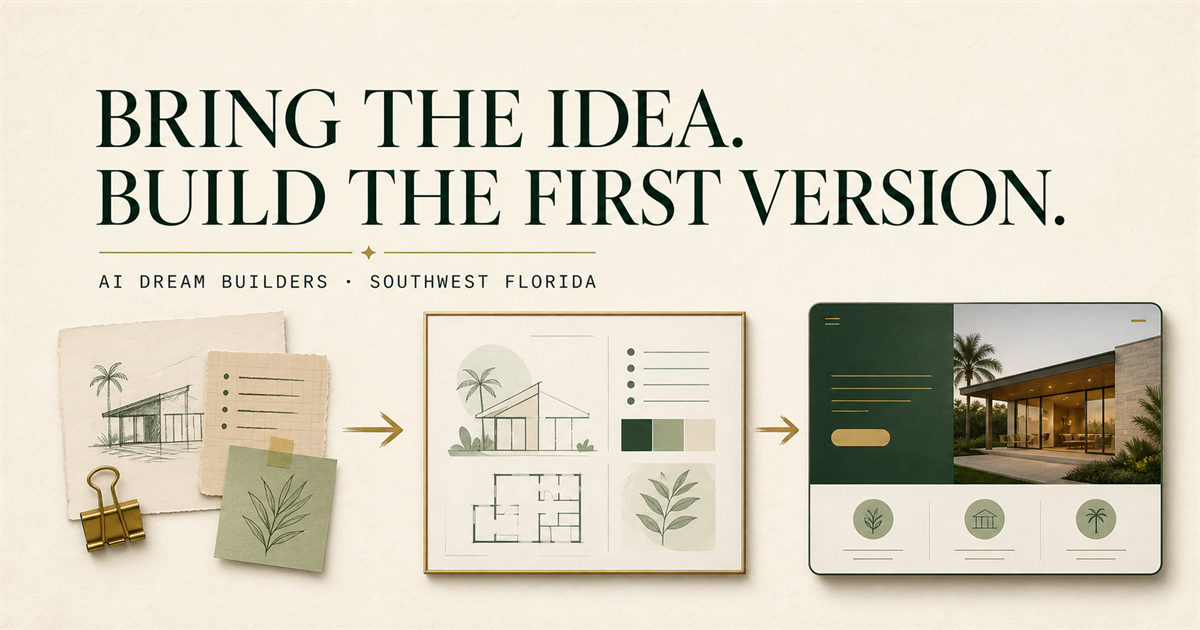
Leave out anything you cannot explain, test, or safely use in a first AI build. A serious first version should focus on one person, one moment, and one visible outcome—not every feature, record, integration, or business promise attached to the idea. The exclusions are not a failure of ambition. They are how you protect time, privacy, and judgment while finding out whether the core idea deserves a larger commitment.
The first version does not need to prove the whole business. It needs to reduce one important uncertainty without creating a new obligation you cannot responsibly carry.
Why leaving things out is a business decision
A capable owner or professional often sees the full picture at once: the customers, exceptions, private records, website, internal workflow, future automation, and eventual revenue model. That experience is valuable. It can also make a first build too broad to evaluate. When everything is included, no one can tell which part is useful, which assumption failed, or who is accountable for a mistake.
The U.S. Small Business Administration treats market research as a way to find and understand customers and competitive analysis as a way to identify an advantage. For a new AI-supported idea, that means the first version should help you learn about a specific customer moment; it is not evidence that customers will buy, that a workflow is compliant, or that an AI output is correct. A small test gives you something concrete to examine before you spend on the larger system.
There is useful Naples context for this kind of practical narrowing. The Greater Naples Chamber's Micro Business Council is a hands-on support network for Collier County businesses with one to 10 employees. That does not prove demand for an AI project or predict a result. It does reinforce a grounded approach: owners can use structured conversations and small experiments instead of trying to solve every operating question alone.
Use a first-version exclusion list
Write these six lines before discussing a build. Use only public, fictional, or material you are authorized to discuss. The list is a conversation guide, not legal, security, financial, or professional advice.
- The one person and moment we will serve: State the role and the narrow situation. Example: a prospective client trying to understand one public service before deciding whether to call.
- The visible first outcome: Name one thing that person can see or try: a clear page, a clickable concept, a human-run intake summary, or a bounded demonstration.
- The question this version should answer: Write one uncertainty, such as whether the explanation is understandable or whether a manual workflow saves a responsible reviewer time.
- What is deliberately out: List the integrations, account access, customer records, automatic actions, edge cases, and promises that are not part of this version.
- What must stay human-owned: Identify the approval, interpretation, exception handling, and final decision that no tool should take over.
- What would change the next decision: Describe the evidence you would need to continue, revise, stop, or bring in a qualified reviewer.
A quick leave-it-out table
- Private or regulated information: Leave it out until the responsible owner has confirmed permissions, data handling, retention, access, and sector requirements. Test with fictional, public, or approved summaries instead.
- Automatic decisions or actions: Leave them out when an output could affect a customer, employee, patient, payment, eligibility, safety, legal position, or public service. Start with a reviewable draft or recommendation that a responsible person can challenge.
- Multiple user types: Leave them out when each audience needs a different promise or workflow. Start with the audience that has the clearest recurring moment and the authority to react honestly.
- Complex integrations: Leave them out when an idea depends on calendars, billing, records, CRMs, or other systems before you know whether the core interaction is useful. A manual or clickable test may answer the earlier question.
- Every exception: Leave them out when the standard case is still untested. Record the exceptions so they are not forgotten, but do not pretend the first version handles them.
- Outcome claims: Leave them out when they rely on future behavior, revenue, compliance, speed, accuracy, or savings that have not been measured. Describe the question being tested instead.
This is not a rule to ignore hard problems. It is a way to make them visible. If an excluded item is actually essential to the value or safety of the idea, that is a signal to pause, do more discovery, or involve the right specialist before building.
Separate confirmed facts, assumptions, and unknowns
Before using ChatGPT or sharing notes with a builder, label each statement. A confirmed fact comes from your direct experience, approved records, or a source you have checked. An assumption is a belief worth testing. An unknown needs research, permission, technical work, or qualified review. This prevents a fluent draft from turning an untested idea into a fake requirement.
- Confirmed: ‘People already ask us this question during the first call.’
- Assumption: ‘They would prefer a short self-service explanation before calling.’
- Unknown: ‘We may use selected client examples or account data in a tool.’
The National Institute of Standards and Technology's AI Risk Management Framework is voluntary guidance, not a substitute for sector-specific requirements. Its practical lesson is still useful here: roles, responsibilities, and human-AI oversight should be clear. A first-version scope should say who checks the output, who can override it, and what happens when the result is uncertain or wrong.
What ChatGPT can help with—and where it stops
ChatGPT can help you turn a safe summary into options, questions, a rough flow, or an exclusion list. Give it a narrow task and ask it to preserve uncertainty. For example:
Using only this safe summary, help me define one visible first outcome and a list of what to exclude. Separate confirmed facts, assumptions, and unknowns. Do not invent customer demand, permissions, legal requirements, results, or technical capabilities. Identify where a responsible human must review or decide.
Treat the result as a draft to challenge. ChatGPT cannot establish that you have permission to use information, decide whether a promise is appropriate, understand unspoken operating constraints, or take responsibility for implementation. Do not put confidential, regulated, client, employee, credential, payment, health, legal, or proprietary details into a public form or general chatbot. Use a fictional example or an approved public summary until the relevant controls have been reviewed.
What a smallest useful version might be
- A decision page: One audience, one question, a clear explanation, and a qualifying next step—without connecting it to internal systems.
- A clickable concept: A few screens that let trusted reviewers react to the flow before there is a functioning application.
- A human-run prototype: A responsible person uses a checklist or draft workflow with approved sample material before anything becomes automated.
- A bounded demonstration: One safe input, one visible output, and an explicit human-review step that tests a technical or experience question.
The right version depends on the uncertainty, not on how impressive it looks. It may be intentionally unglamorous. Its job is to create a clearer next decision with less irreversible cost.
Who this approach fits—and who should pause
This approach fits a Naples or Collier County professional, owner, adviser, consultant, manager, or serious founder who has useful subject-matter experience, authority to move an idea forward, and willingness to test a small artifact honestly. It is especially useful when you have notes, a sketch, a website problem, or a ChatGPT conversation but do not yet have a stable specification.
Pause before using this approach if the first useful version must immediately make high-stakes decisions, process sensitive data, meet a regulated requirement, or connect to systems you do not control. It is also not a fit for a guaranteed business result, a free prompt library, or an instant full application. Those conditions call for a different kind of review, evidence, and responsibility.
Turn the exclusion list into a conversation
If you want to see how a careful builder approaches scope, review Zechariah's background and working approach and the Naples guide to choosing AI project help. The earlier guide explains the different working relationships; this one helps you arrive with an honest boundary around the first thing to make.
When you are ready, bring a safe summary and your exclusion list. You bring the experience, notes, and decision authority. Zechariah helps you choose and build the smallest useful version, including the parts that should remain out of scope until the evidence and safeguards are ready.
Sources and local context
- Market research and competitive analysis — U.S. Small Business Administration
- Micro Business Council — Greater Naples Chamber of Commerce
- NIST AI RMF Playbook — National Institute of Standards and Technology