Can a ChatGPT Conversation Become a First AI Prototype? Turn It Into a Reviewable Brief.
By Zechariah Myrick · September 7, 2026 · 8 min read
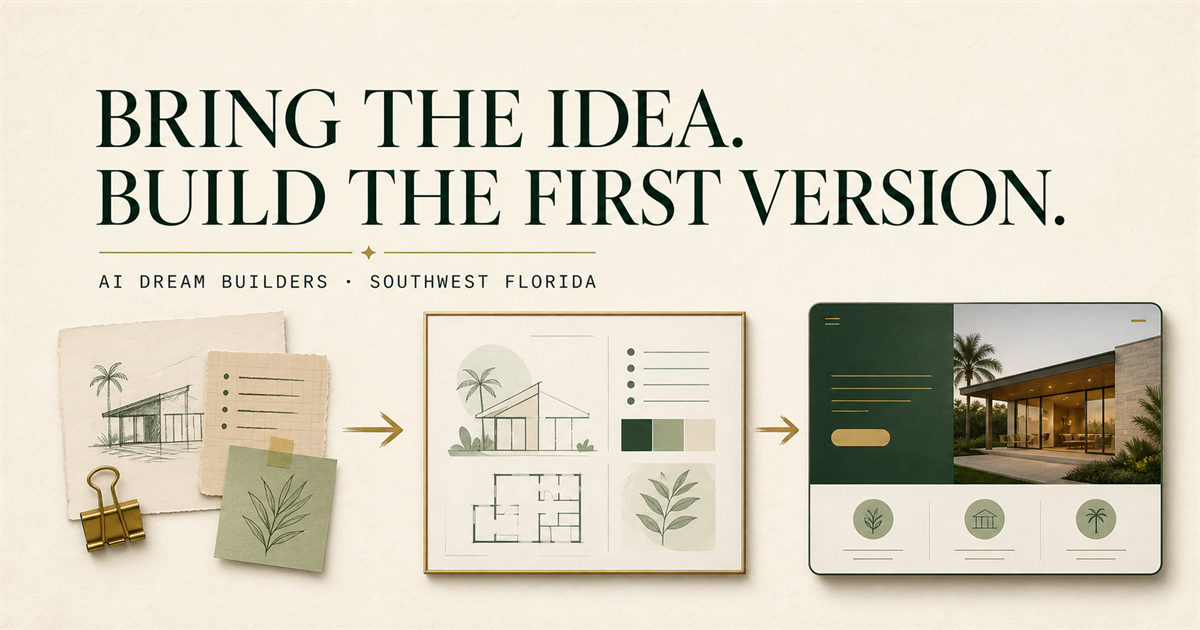
Yes—but the conversation needs to become a reviewable brief before it becomes a prototype. Save only the approved, non-sensitive parts of the exchange, then name one work moment, one visible result, a human review point, and the next decision it should inform. For a Naples or Collier County owner, professional, adviser, consultant, manager, or serious founder, that brief turns an interesting chat into something a responsible person can inspect and decide whether to test.
A ChatGPT conversation can surface an idea or clarify language. It does not prove demand, accuracy, permission, security, accessibility, compliance, or readiness to build a customer-facing tool.
A chat thread is evidence of a question—not a build plan
A useful exchange may reveal a repeated question, a confusing handoff, a draft explanation, or a step people keep doing manually. That is valuable starting material. It is still easy to mistake fluent text for a settled product decision. A prototype needs a narrower promise: it should make one approved interaction visible so an accountable person can learn something specific.
The U.S. Small Business Administration describes market research as a way to understand customers and improve an idea. A short prototype brief is not market proof; it is a practical way to state what needs learning next. It can help distinguish a confirmed work fact from an assumption the first version should test and an unknown that needs a different kind of review.
Naples and Collier County are decision context, not proof that a particular AI idea has demand. The useful advantage of an established owner or adviser is direct knowledge of the work and authority to choose a small, accountable next step.
Use a five-part conversation-to-brief card
Use only material you are allowed to discuss. This is a planning aid, not legal, privacy, security, accessibility, financial, health, employment, or professional advice.
- 1. The work moment: In one sentence, name when the problem occurs. Example: ‘An owner needs to compare two approved public service paths before rewriting a website page.’
- 2. The approved starting material: Identify public, fictional, or authorized notes that can safely support a demonstration. Do not paste a client thread, employee record, credentials, payment details, health or legal information, confidential material, or proprietary files into a general chatbot or public form.
- 3. The visible result: State what someone will see or try: a side-by-side comparison, a fictional walkthrough, a draft outline, or a simple decision page. Keep it to one interaction.
- 4. The human review point: Name who checks whether the result is understandable and useful. A prototype does not replace that owner’s judgment.
- 5. The next decision and stop condition: Write what the test could clarify—continue, revise, run a manual test, seek specialist review, or pause—and what immediately ends the test.
Choose the smallest honest first version
A one-page explanation. Choose this when the chat mostly improved how you explain an approved public offer, process, or next step. The first version can show whether the explanation is clear without pretending it is personalized advice.
A fictional walkthrough. Choose this when a person needs to see a sequence. Invent the details, label assumptions, and ask a reviewer whether the steps make sense. Do not make a thinly disguised real client story by removing a name while retaining distinctive facts.
A manual test. Choose this when the eventual value depends on a real action but the output has not been shown useful yet. Keep a person responsible for the real work, record what happened, and use the result to decide whether a more defined build is justified.
A pause for specialist review. Choose this when the core value depends on private records, eligibility, employment, health, legal matters, payments, credentials, safety, accessibility, or another consequential decision. A better prompt is not a substitute for authorization, controls, or qualified review.
Keep facts, assumptions, and unknowns visible
NIST’s voluntary AI Risk Management Framework emphasizes documented roles, oversight, and feedback. In a first-version brief, that means being plain about what is confirmed, what the team is assuming, who can review the result, and what remains unknown. A polished chat response does not establish those boundaries on its own.
For example: ‘This public service description is approved for a demonstration’ is a fact to verify. ‘A visitor will understand the comparison’ is an assumption to test. ‘Whether a future tool may use a visitor’s information or trigger a real action’ is an unknown until appropriate permissions, process controls, and accountable review exist.
What ChatGPT can help with—and where it stops
ChatGPT can help summarize approved public notes, identify one visible interaction, draft a fictional walkthrough, or label facts, assumptions, and unknowns. A bounded request could be: ‘Using only this approved public information, create a one-page prototype brief with one work moment, one visible result, a named human review point, and a stop condition. Do not invent customer facts, permissions, policies, security controls, eligibility, results, or availability.’ A responsible person must review the output before it is used.
ChatGPT cannot validate demand, authorize use of information, determine whether a person may receive a result, establish compliance, make a consequential decision, or accept accountability for what happens next. Do not put confidential, regulated, client, employee, credential, payment, health, legal, or proprietary details in a public form or general chatbot.
Who this fits—and who should pause
This fits a decision-maker with subject-matter experience, notes, a sketch, a workflow, a website question, or a ChatGPT conversation who wants to make one useful moment tangible. The paid-worthy outcome is an accountable choice of the smallest useful version and its boundary—not a promise that a chat thread is ready to become a product.
It does not fit someone seeking free prompts, an immediate full launch, a guarantee, or a shortcut around privacy, security, permissions, accessibility, professional judgment, or specialist review. Those concerns need a responsible owner and, where appropriate, qualified help before a general prototype is considered.
Turn the brief into a useful build conversation
For the human approach behind a first version, see Zechariah’s background and working approach and the related guide on what to bring to a first AI idea session. The session guide helps organize a safe starting point; this brief helps turn the most useful part of a conversation into one reviewable interaction.
If you can bring a safe summary, the one work moment your conversation surfaced, and the decision you need to make, bring them to an idea-to-prototype conversation. You bring the experience and material you are allowed to discuss. Zechariah helps choose and build the smallest useful version—and identify when a manual test, clearer brief, or specialist review is the more accountable next move.
Sources and local context
- Market research and competitive analysis — U.S. Small Business Administration
- AI Risk Management Framework — National Institute of Standards and Technology
- Data Usage for Consumer Services FAQ — OpenAI Help Center