What to Bring to a First AI Idea Session in Naples
By Zechariah Myrick · August 26, 2026 · 9 min read
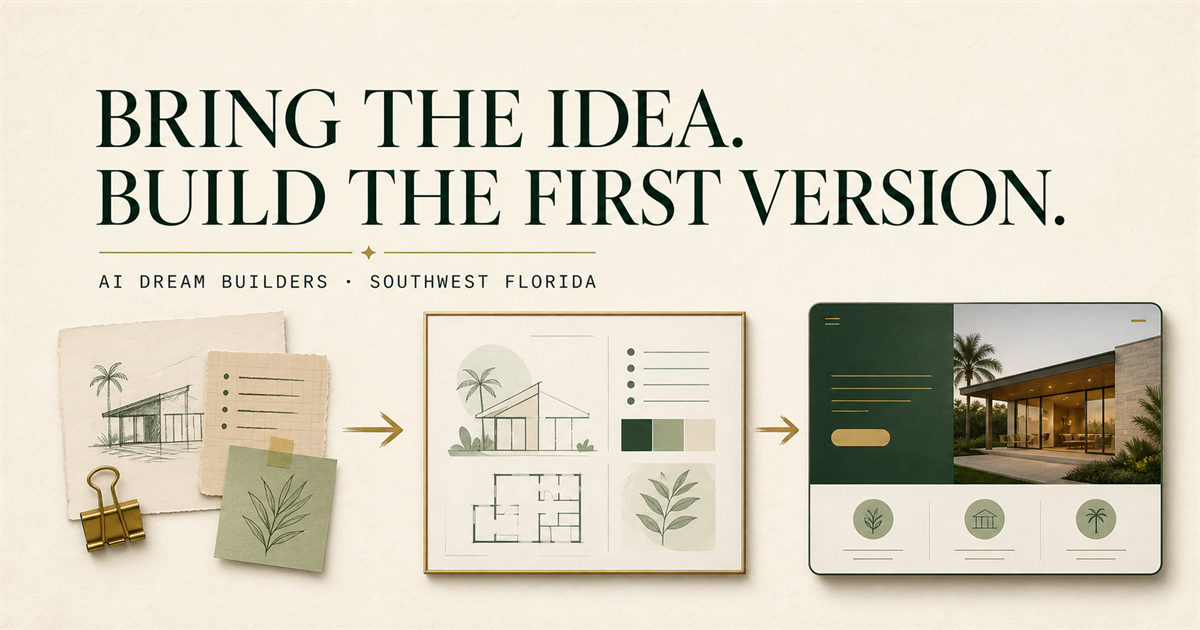
A good first AI idea session does not begin with a software package. It begins with what you know, who you want to help, and the one useful thing another person should be able to see or try. Bring your rough notes, a sketch, or a safe summary of the ChatGPT conversation you already have. You do not need a polished pitch, technical vocabulary, or every answer.
Bring the useful material you already have. Leave out confidential or regulated details. The goal is to choose the smallest useful first version—not to force a large project.
What a first AI idea session is actually for
A first session is a narrowing conversation. It should turn an interesting but scattered idea into a decision you can inspect: who the first version is for, which moment it helps with, what it will show, what must stay human-reviewed, and what you need to learn before spending more.
The Greater Naples Chamber describes its Micro Business Council as a hands-on support network for Collier County businesses with one to 10 employees. That is useful local context, not proof that AI consulting is popular or that a particular project will work. It does reinforce a sensible principle: an owner does not have to solve every business decision alone.
The U.S. Small Business Administration makes a related point in its planning guidance: market research helps find customers, competitive analysis helps identify an advantage, and a plan should fit the business's actual needs. An AI conversation should support that work, not replace evidence from customers, records, or responsible professional review.
Bring this one-page starting sheet
Short answers are enough. Use public, fictional, or information you are authorized to discuss.
- The person: Name the role or situation you hope to help, not a broad demographic label. A local professional with a specialized idea is more useful than ‘everyone.’
- The moment: Describe one recurring friction, decision, or opportunity in plain language. What is slow, confusing, expensive, inconsistent, or still only an idea?
- Your evidence: List what you know from direct experience or verified sources. Keep assumptions and unknowns in separate sections.
- The first visible outcome: Write one thing a person could see, test, or use. It might be a page, a clickable concept, a manual workflow, or a limited demonstration.
- The boundaries: Note what must stay private, require human review, or remain outside the first version.
- The next decision: State what you want to know after someone sees the first version. Should you continue, revise, stop, or speak with a particular kind of expert?
Label facts, assumptions, and unknowns
This simple separation prevents a confident AI answer from becoming fake evidence. ‘I have personally answered this customer question every week’ is a fact about your experience. ‘Customers will pay for a self-service version’ is an assumption. ‘We are allowed to use client records in this tool’ is an unknown until the responsible owner confirms the rules and controls.
- Confirmed: Direct observations, approved records, public materials, and primary sources you have checked.
- Assumption: A belief that can be tested with a conversation, demonstration, or limited pilot.
- Unknown: A question that needs research, permission, technical testing, or qualified professional review.
What to bring from a ChatGPT conversation
A long transcript can be useful, but it is rarely the best starting document. Bring a short summary: your original question, the two or three directions that still interest you, facts you verified, and the decision you still cannot make. If the conversation contains sensitive information, do not forward the raw thread. Create a safe summary first.
You can also bring screenshots of a public example, a rough drawing, a voice-note summary, or the current manual process. Imperfect material is welcome. The important thing is knowing which parts come from you and which parts were generated by a tool.
What not to put in a public form or general chatbot
Do not submit client files, employee records, passwords, payment details, protected health information, legal strategy, confidential financial material, private contracts, or proprietary data through a public contact form or a general chatbot. Use a fictional example or an authorized public summary until the project's privacy, security, ownership, and sector requirements have been reviewed.
If the idea affects health, law, finance, employment, safety, government, education, accessibility, procurement, or another regulated area, the right qualified reviewer belongs in the plan. A prototype is not a shortcut around professional responsibility.
What you can do before contacting anyone
Use ChatGPT to organize your thinking, but give it a narrow job and tell it not to invent evidence. A useful prompt is:
I have experience in [area] and an idea for [person] during [specific moment]. Here are my confirmed facts, assumptions, and unknowns: [safe summary]. Do not invent market facts, customer quotes, legal requirements, or results. Help me identify the smallest visible outcome, three questions to test, boundaries needing human review, and information I should verify before a build.
Treat the result as an outline to challenge, not as proof. Check important claims against primary sources and your own records. Then ask one person who resembles the intended user to react to the problem and proposed outcome—not to praise the technology.
Four realistic first versions
- A clear offer page: One audience, one problem, one explanation, and one qualifying next step.
- A clickable concept: A few screens that let trusted reviewers react to an experience before software is built.
- A human-run workflow: A checklist, intake summary, or response draft tested manually with fictional or approved information before automation.
- A bounded demonstration: One input, one visible output, and an explicit human-review step that helps answer a specific question.
The right first version reduces one important uncertainty. It does not need to look like a complete app, and it should not promise a business result before real people have responded to it.
Where ChatGPT stops and hands-on help begins
ChatGPT can generate alternatives, summarize safe notes, and expose missing questions quickly. It cannot see your unspoken constraints, establish permission, verify every source, choose a responsible data boundary, or be accountable for implementation decisions.
Hands-on help begins when someone needs to ask the narrowing questions, distinguish facts from assumptions, choose what not to build, make the idea visible, and carry the technical work into a reviewable first version. You bring the subject knowledge and authority. A builder helps turn it into something small enough to evaluate. You can review Zechariah's background and working approach before deciding whether that collaboration fits.
Who this is a good fit for
- A professional, owner, adviser, consultant, manager, or serious founder with useful subject-matter experience.
- Someone who owns the decision or can involve the person who does.
- Someone willing to review a small version and make choices as the work becomes clearer.
- Someone who values a written scope, honest boundaries, and a reversible first step.
It is not a fit for someone seeking a guaranteed outcome, a free library of prompts, an instant full application, or a way around privacy, security, accessibility, legal, financial, or professional obligations.
What you should leave the first conversation with
A useful conversation should leave you with a clearer intended user, visible first outcome, evidence list, boundaries, acceptance check, and next decision. If paid work makes sense, the next step can be a written scope that states what is included, what is excluded, which assumptions still need verification, and what you will review before anything expands.
If you are unsure whether you need coaching, advice, a technical developer, or someone who can help decide and build, read how to choose the right kind of AI project help in Naples. If your real concern is an existing website that gets attention but few inquiries, start with the Southwest Florida GEO and website-visibility guide.
Bring the idea, not a sales-ready pitch
You can bring a safe summary of your idea or ChatGPT conversation. The first goal is simply to understand the idea, choose the smallest useful version, and decide whether a written scope is worthwhile. There is no need to choose a package before the problem is clear.
Sources and local context
- Plan your business — U.S. Small Business Administration
- Micro Business Council — Greater Naples Chamber of Commerce