
Design Study: Swamp-Ready Edge Computer Vision for the Florida Everglades
By Zechariah Myrick · May 20, 2026 · 3 min read
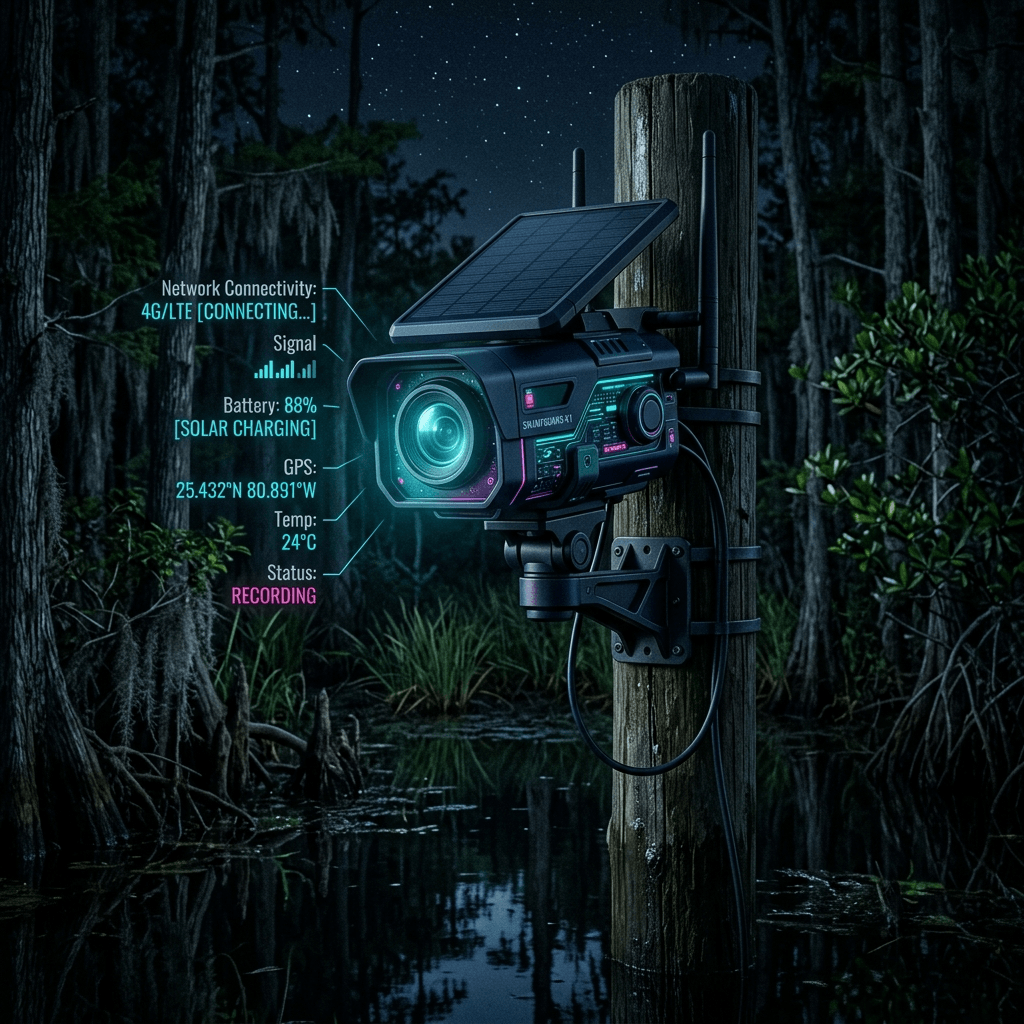
This is an architecture design study, not a report of a deployed Everglades system. A field device in South Florida's wet season may face heat, humidity, heavy rain, insects, variable solar input, and difficult access. The environment is therefore the primary design input, and every proposed component still needs site-specific engineering and permission.
Consider a monitoring brief with no grid power and inconsistent cellular coverage: review wildlife activity or sensor events, keep raw data local by default, and send a compact alert when the connection is available. The right first deliverable is an instrumented prototype and field-test plan, not a promise of continuous operation.
The design brief: edge compute meets an outdoor enclosure
Outdoor computer vision creates a coupled thermal and electrical problem. Model size affects power draw; power draw affects heat; the enclosure affects both heat rejection and moisture protection. Start with a daily energy budget and required duty cycle, then select the model and hardware that fit those constraints.
A plausible prototype might pair an outdoor-rated enclosure, passive thermal path, low-power Jetson, charge controller, battery, and solar panel. TensorRT and lower-precision inference may reduce latency and energy use, but enclosure temperature, accuracy, and daily energy balance must be measured together during bench and field tests.
Invasive-species review as a computer-vision example
Invasive-species monitoring illustrates the value and limits of edge vision. Camera traps can create large volumes of uneventful footage, while camouflage, vegetation, weather, and partial views make classification difficult. The useful role for a model is to prioritize candidate clips for trained reviewers, not to declare a confirmed sighting on its own.
A responsible prototype would compare RGB and thermal inputs, measure recall on representative habitat footage, and tune for a review workload the team can actually handle. The device can keep full-resolution imagery local, queue a small thumbnail or event record under an approved retention policy, and transmit it over the available link. Every alert remains a candidate until a person verifies it.
Telemetry: The Art of Doing More with Less
For a remote site, battery state and communication health are first-class data. A practical firmware plan can include:
- Event-triggered capture: Use an appropriate low-power sensor to wake the higher-power compute only when needed.
- Measured startup behavior: Test how long the camera and inference pipeline take to become useful after sleep, including failure cases.
- Energy-aware scheduling: Defer non-urgent processing when battery state is low and report the degraded mode to operators.
- Store and forward: Queue approved event data within a fixed storage budget and retry transmission without blocking local monitoring.
A credible field plan connects mechanical, electrical, software, scientific, and operating requirements. Before calling the system deployable, publish the acceptance tests: thermal limits, energy balance, detection metrics, offline duration, recovery behavior, retention policy, and the human review process. USGS researchers already use multiple methods to study invasive reptiles in the Greater Everglades; any computer-vision experiment should begin with the responsible agency's research question and field protocol rather than assume a camera model is the missing answer.
If you work in environmental monitoring, what observation creates the largest review burden today: empty footage, species triage, equipment health, water conditions, or something else? A useful next design note should begin with that field question and the conditions a device must survive.
Sources and local context
- Weather in Everglades National Park — Everglades National Park
- USGS Everglades Research Office - Florida — U.S. Geological Survey
- Everglades Invasive Reptile and Amphibian Monitoring Program — U.S. Geological Survey
- AI Risk Management Framework Core — NIST AI Resource Center
- Understand Extended Offline Capabilities for IoT Edge Devices — Microsoft Learn