
Livestock Computer Vision Research Note: Testing Cattle Muzzle Identification
By Zechariah Myrick · May 15, 2026 · 5 min read
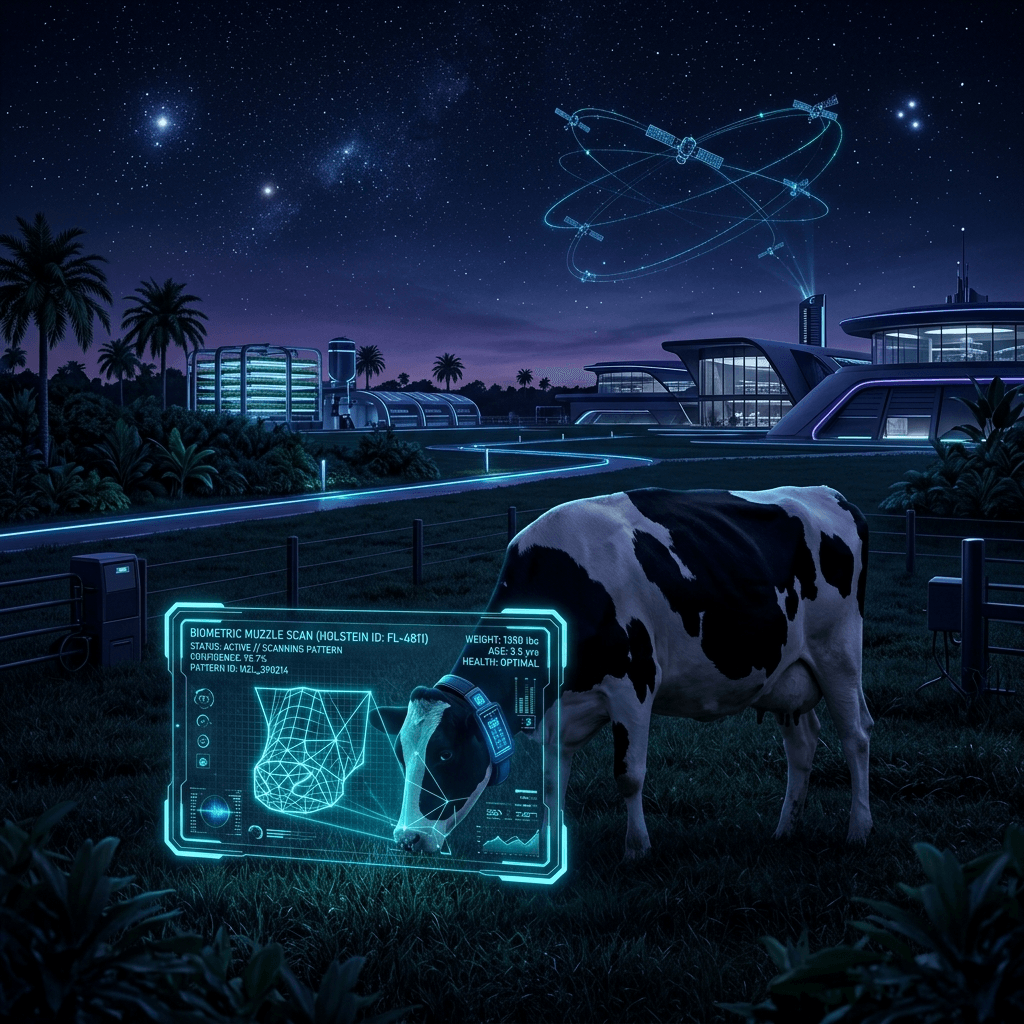
This is a research and portfolio note, not a deployed cattle-identification product and not a report of validation results from a Southwest Florida herd. Its purpose is to make the technical and operational test explicit: can muzzle imagery add a useful supplemental identity signal under representative field conditions without displacing required official identification?
Project status: research prototype. The interactive below illustrates a candidate review flow; it is not evidence of biometric accuracy, field reliability, regulatory acceptance, or a production deployment.
Livestock operations need reliable links between an animal and its records. USDA APHIS defines official identification requirements for covered interstate movements, so a research biometric should be evaluated as a supplemental signal rather than represented as a substitute for required devices or records. The narrower question is whether close-up muzzle imagery helps reconcile identity in a particular workflow and under which capture conditions.
The muzzle image as a candidate biometric
Published studies report promising results from cattle muzzle imagery, but their data sets, capture procedures, animal populations, and evaluation protocols differ. A product cannot transfer a paper's accuracy number directly into a farm workflow or assume uniqueness and permanence without longitudinal evidence. Head movement, distance, focus, moisture, dirt, partial views, device differences, and repeated capture sessions all change the problem.
A candidate two-stage pipeline first detects and grades the muzzle crop, then maps an acceptable image into an embedding for similarity search. The important outputs are not only the closest match, but image-quality flags, confidence calibration, and a clear 'no decision' path when the evidence is weak.
Building a field-validation dataset
A useful validation set must represent the intended workflow: multiple days, devices, distances, lighting conditions, head angles, and ordinary contamination such as water or mud. Animal identities and capture sessions need deliberate splits. If nearly identical images from one session leak across training and testing, the reported result may reward background, device, or session shortcuts rather than durable biometric information.
Test verification, identification, and rejection separately
- Verification: Given a claimed animal identity, do two samples appear to come from the same animal?
- Identification: Given one sample, can the system search an enrolled gallery and return a useful candidate set?
- Open-set rejection: Can the system avoid forcing a match when the animal is not enrolled or the image is inadequate?
- Capture success: How often can the workflow obtain an image that meets the quality gate without creating unreasonable handling time or stress?
- Longitudinal performance: Do thresholds remain useful across days, growth, weather, devices, and normal field contamination?
A future gate workflow could pair a camera event with an official tag read, weight, timestamp, or another authorized signal, but the biometric output should be accepted only when quality and calibrated confidence thresholds are met. Ambiguous cases should be queued for a person or reconciled with another identifier. Multimodal evidence may be more useful than asking one image to carry the whole decision.
From research metric to product decision
The go or no-go decision needs more than a strong demo. Measure false matches, missed matches, no-decision rate, capture success, operator review time, animal-handling impact, and performance weeks or months after enrollment. Any local field study would require an appropriate livestock partner, permissions, welfare-aware capture protocol, official ground truth, and a prewritten evaluation plan. The evidence should decide whether the idea progresses.
If you work with cattle records or handling systems, where does identity become hardest to confirm today: entry, processing, weighing, treatment, transport, or reconciliation after the event? That workflow question is more useful than beginning with a model architecture.
Sources and local context
- Animal Disease Traceability — USDA Animal and Plant Health Inspection Service
- Individual Beef Cattle Identification Using Muzzle Images and Deep Learning Techniques — Animals / PubMed
- The Muzzle as a Biometric Feature: Cattle Identification Using Unique Muzzle Patterns — Pattern Recognition
- Cattle Identification Based on Multiple Feature Decision Layer Fusion — Scientific Reports